PAHAI Lab
Persuasive and Affective Human–AI Interaction Laboratory
A Global Laboratory for Human–AI Interaction
PAHAI Lab explores how humans and AI can understand each other’s emotions and intentions, build appropriate trust, and collaborate naturally in changing situations.
We study how AI agents, robots, and immersive environments can respond to human emotions, nonverbal behavior, and physiological signals to support learning, decision-making, behavior change, communication, and social connection.
Our research combines generative AI and large language models, embodied AI, social agents and robots, VR/MR/XR, affective computing, and physiological sensing. We place particular emphasis on building working interactive systems and evaluating them through user studies.
Research Areas
- Human–AI Interaction and Human–Agent Interaction
- Affective Computing
- Embodied AI and Social Agents
- Persuasive Technology and Behavior Change
- Generative AI and Conversational Agents
- VR, MR, XR, and Metaverse Interaction
- Nonverbal and Multimodal Interaction
- Serious Games and Affective Learning
- Physiological and Neural Sensing
Awards
PAHAI Lab members and research projects have received awards at international conferences, academic societies, and student competitions.
Current Members
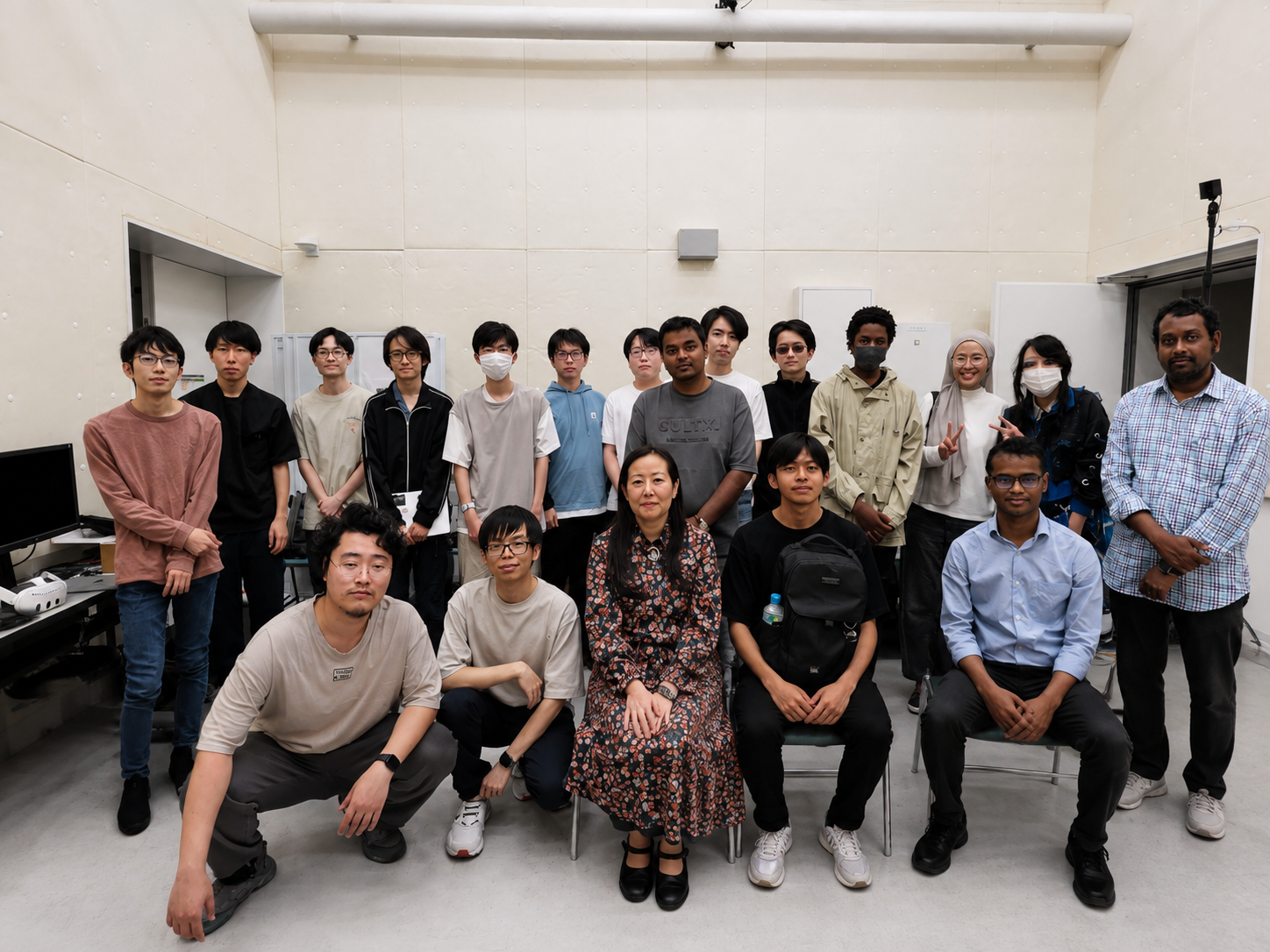
Doctoral Students
Third Year
- Candy Joyce Herminado Espulgar —
 Philippines
Second Year
- Pakpoom Chaimook —
 Thailand
- Sandra Mae Famador — Philippines
Master’s Students
Second Year
- Takeru Ohta —
 Japan
- Andrew Wanyonyi Kipruto —
 Kenya
- Kyosuke Saga — Japan
- Hayato Nagasawa — Japan
- Iffah Nurain Binti Zulkarnain —
 Malaysia
Second Year, September Intake
- Md. Abdul Momin —
 Bangladesh
First Year
- Shun Suzuki — Japan
- Daichi Nakano — Japan
- Mushfiqur Rahman Joseph — Bangladesh
- Md. Ismail Hossain — Bangladesh
First Year, September Intake
- Wang Zhiwei —
 China
Undergraduate Students
Fourth Year
- Shota Isokado — Japan
- Kosuke Sato — Japan
- Haruta Sugawara — Japan
- Yuta Abe — Japan
- Satoru Kimura — Japan
- Ryota Kuroda — Japan
- Haruto Sato — Japan
Research Students
- Herman Remy —
 United States
- John Pena — United States
Special Research Students and Short-term Research in 2026
- Antonio Rivera Pérez —
 Mexico (June 2026)
- Taran Shetty —
 India (November 2026)
Special Research Students and Short-term Research in 2027
- Cervilla Enzo —
 France (February–June 2027, planned)
Research Environment
PAHAI Lab uses Furhat social robots, VR and MR headsets, generative AI and large language models, physiological sensors, EEG devices, and other interactive technologies to build research systems that allow people to experience new forms of human–AI interaction.
Students are encouraged to participate in the full research process, from idea development and system design to implementation, user studies, and data analysis. Rather than simply applying existing AI or XR tools, we aim to create new forms of interaction and experimentally investigate how people feel, behave, and build relationships with AI.
Student projects are encouraged to develop toward presentations and publications in areas such as Human–AI Interaction, Affective Computing, VR/MR, Persuasive Technology, and related fields.
For Prospective Students
PAHAI Lab welcomes students who want to go beyond using AI and instead design, build, and evaluate new forms of human–AI interaction.
The lab is particularly suitable for students interested in programming, interactive system development, user studies, multimodal data analysis, robotics, VR/MR, affective computing, generative AI, and serious games.
Research topics are developed by connecting each student’s interests with ongoing work in Human–AI Interaction, embodied AI, emotion and nonverbal behavior, Persuasive Technology, XR, and affective learning. Research meetings and supervision can be conducted in English, and international students are active members of the laboratory.
If you are considering joining the laboratory as an undergraduate researcher, graduate student, research student, or international applicant, please visit my official Future University Hakodate faculty page for detailed information on admission, application requirements, scholarships, and required documents.
New Inquiries and Applications
Kaoru Lab Office: kaorulab.office [at] gmail.com
Replace [at] with @ when sending email.
For new inquiries about graduate study, research-student (kenkyusei), internship or postdoctoral opportunities, or research collaboration, please contact the lab office.
Student inquiries and follow-up correspondence should remain with the Kaoru Lab Office unless Prof. Kaoru Sumi explicitly asks you to contact her directly.
Replies are prepared with AI assistance and reviewed by Prof. Kaoru Sumi.
Prospective Master’s and PhD students should first review the research themes, application requirements, required documents, and funding information on the official faculty page, then complete the Prospective Student Application Form.
After submitting the form, please email the lab office a short confirmation of your submission. Do not send application documents by email or attach the same documents again.
Applications received by the 20th of each month are normally reviewed by the end of that month. Later submissions normally enter the following month’s review cycle.
For university admission procedures or inquiries about other laboratories, please use the official admissions page.
Existing research collaborators may continue to contact Prof. Kaoru Sumi directly at kaorus [at] fun.ac.jp.
International Community
PAHAI Lab brings together Japanese and international students and maintains active research collaborations with universities and research institutions overseas. We have welcomed degree students, research students, short-term visiting students, and researchers from countries and regions across Asia, Europe, and North America.
A major feature of the laboratory is that members with different cultural and academic backgrounds discuss research questions together, build systems collaboratively, and communicate their findings internationally.
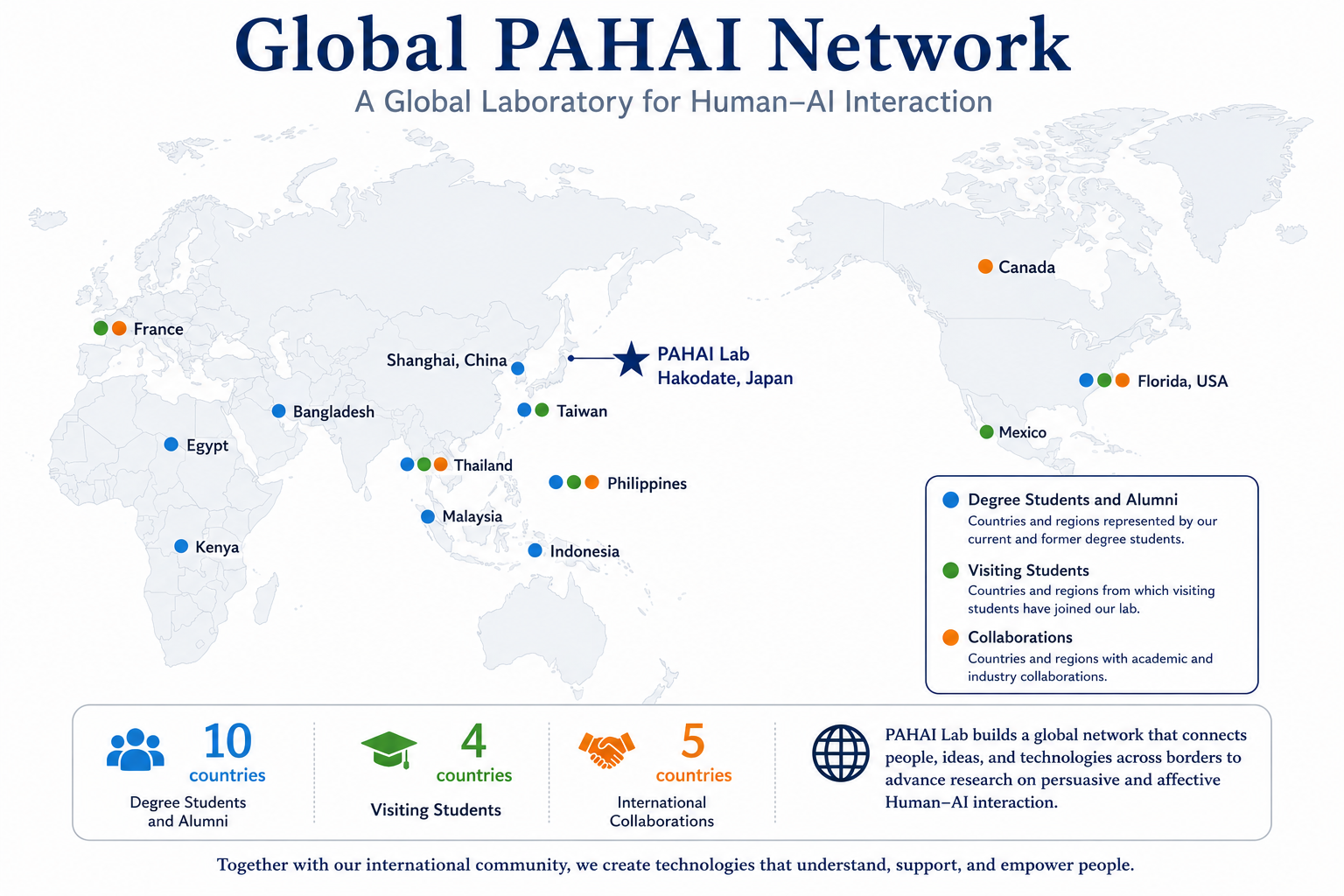
Click the map to view a larger version.
Countries and Regions of Current and Former Degree Students
- Japan
- Thailand
- Philippines
-
 Egypt
-
 Indonesia
-
 Taiwan
- China
- Kenya
- Malaysia
- Bangladesh
Research Students, Short-term Research, and Exchange
- India
- United States
- France
- Mexico
- Taiwan
International Collaborations
PAHAI Lab has conducted academic and industry collaborations across several countries and regions.
- France
- Philippines
- Thailand
-
 Canada
- United States
- Malaysia
The laboratory also collaborates with Japanese game companies and interactive technology companies.
PAHAI Lab continues to welcome motivated students and researchers from Japan and overseas.